
Quick answer
Ancient people were not trapped between instant spoilage and alcohol. The preservation chart used in these studies shows three workable paths from grapes to stored wine: concentrated syrup without alcohol, boiled wine without alcohol, and fermented wine with alcohol.
The point is that fermentation was not the only preservation path for ancient households, and it was not the easiest path.
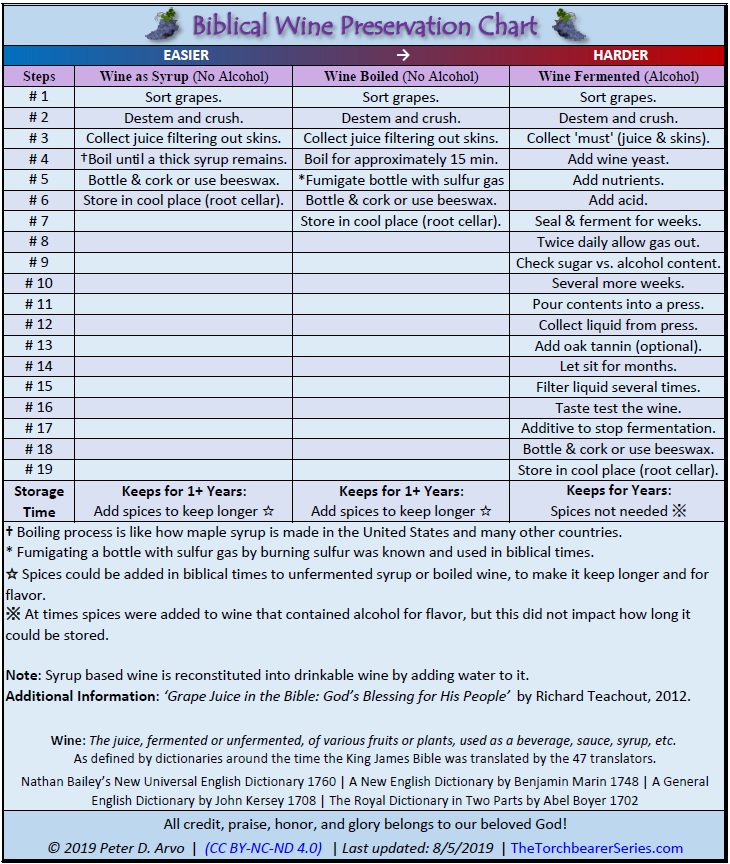
Three preservation paths
The preservation argument matters because many modern claims assume grape liquid could only be kept by turning it alcoholic. The chart challenges that assumption directly.
| Path | Core steps from the chart | What stands out |
|---|---|---|
| Wine as syrup (no alcohol) | Sort grapes → destem and crush → collect filtered juice → boil until thick syrup remains → bottle/cork or beeswax → cool storage | The chart treats this as the shortest preservation path and notes that syrup can later be reconstituted with water. |
| Wine boiled (no alcohol) | Sort grapes → destem and crush → collect filtered juice → boil about 15 minutes → optional sulfur fumigation of the bottle → bottle/cork or beeswax → cool storage | This still preserves grape juice without requiring fermentation. |
| Wine fermented (alcohol) | Sort grapes → destem and crush → collect must with skins → add yeast → add nutrients → add acid → seal and ferment → vent gas → monitor sugar/alcohol → press → filter repeatedly → stop fermentation → bottle/cork → cool storage | The chart presents this as the longest and most intervention-heavy path. |
Similarities to modern process work today
The same broad kinds of actions still show up in modern fruit processing and winemaking: sorting fruit, crushing it, separating or straining juice, heating when concentration is desired, filling containers, sealing them, and storing the finished product carefully.
Modern grape juice, jelly, and syrup recipes still use crushing, heating, straining, filling, sealing, and processing steps. Modern fermented wine production still uses receiving fruit, crushing, pressing, fermentation management, filtering, and bottling. The old question is not whether people knew how to process grapes. They did. The question is which process a given Bible passage assumes.
Why the “alcohol was the easy option” assumption fails
The chart itself shows the problem. The syrup path is six steps. The boiled path is seven. The fermented path runs much longer and includes extra interventions such as added wine yeast, added nutrients, added acid, monitored fermentation, repeated filtering, and a stopping step.
That does not mean ancient people never fermented wine. It means the common claim that alcohol was the only practical way, or easiest way, to preserve grape juice is not an accurate claim.
Why this matters for Bible reading
If positive wine texts can refer to preserved grape products that are not intoxicating, then Bible passages about blessing, offerings, and fruitfulness do not automatically become endorsements of drinking alcohol.
That is why this page should be read with Biblical wine preservation, types of wine in the Bible, two wines in the Bible, and was wine in the Bible alcoholic?
Related pages
- Biblical wine preservation
- Biblical Wine Preservation Chart
- Grape juice in Bible times
- Sweet wine, preserved must, and syrup
- Was wine in the Bible alcoholic?
- Wine in the Bible
Modern process parallels: University of Minnesota Extension on grape juice extraction and University of Minnesota Extension on fruit spreads.
Ancient and modern parallels
The preservation chart is helpful partly because it makes the modern parallel easy to see. The non-alcoholic paths do not depend on mysterious lost technology. They depend on familiar steps: sort the fruit, crush it, separate the juice, use heat where needed, seal it well, and store it cool.
| Path | Ancient step pattern | Clear modern parallel |
|---|---|---|
| Wine as syrup | Filtered juice boiled down to a thick concentrate, sealed, and stored cool. | Maple syrup and fruit concentrates show the same basic preservation idea: remove water by heat and store the concentrated product. |
| Wine boiled | Juice briefly boiled, sealed, sometimes protected with sulfur, then stored cool. | Modern pasteurising and bottling follow the same broad logic: heat, seal, and reduce spoilage risk. |
| Wine fermented | Must kept with skins, wine yeast activity managed, gas released, alcohol formed, then the liquid clarified and bottled (see chart for full process). | Modern alcoholic winemaking still requires a longer chain of managed steps than simply concentrating or briefly boiling juice. |
The practical conclusion is straightforward: fermentation was one preservation path, but not the only path and not the easiest one.
Frequently asked questions
Does this page claim every positive wine text is syrup?
No. It shows that non-alcoholic preservation paths were real and easy enough that positive passages do not have to be forced into alcohol by default.
Why compare ancient work with modern processing?
Because the same basic actions still make sense: sort, crush, separate, heat when needed, bottle, seal, and store. That makes the ancient preservation discussion easier for modern readers to picture.
Sub-guides on this topic
Preservation study
How grape juice was preserved without alcohol in Bible times
A detailed study of how grape juice could be preserved without alcohol in Bible times, using syrup, boiling, sealing, sulfur, spices, and cool storage.