
Quick answer
The preservation chart supplied lays out two non-alcoholic preservation paths before it reaches the longer fermented path: wine as syrup and wine boiled. Both end with sealing and cool storage. That means the assumption “grape juice had to become alcohol to keep” is not accurate.
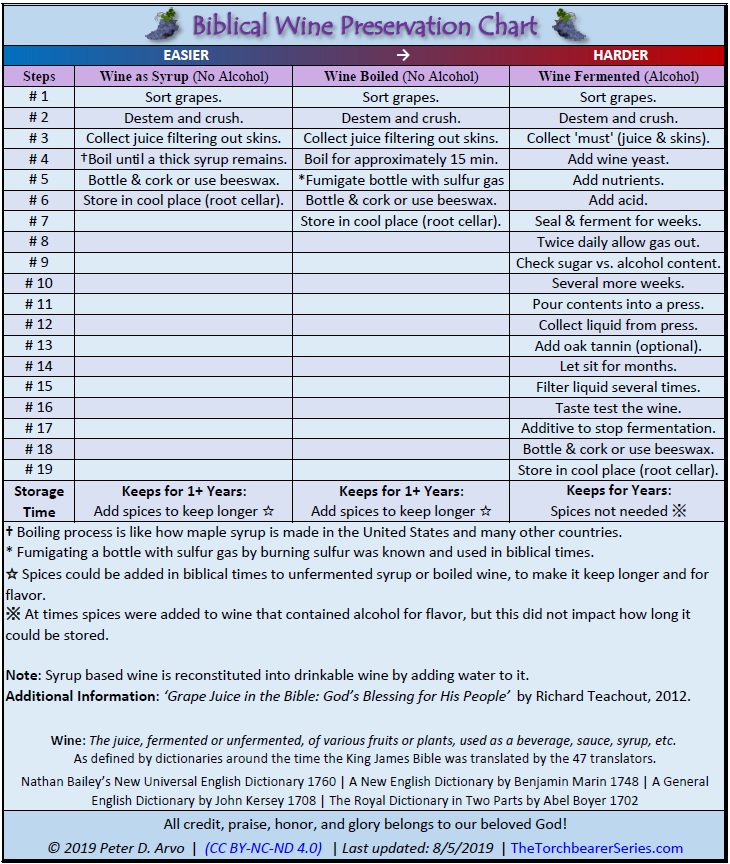
What the preservation chart shows
| Method | Key steps from the chart | Why the step matters |
|---|---|---|
| Syrup wine (no alcohol) | Sort grapes → destem and crush → collect filtered juice → boil until a thick syrup remains → bottle and cork or use beeswax → store cool. | Concentration removes enough water to make long storage practical, then sealing and cool storage protect what remains. |
| Boiled wine (no alcohol) | Sort grapes → destem and crush → collect filtered juice → boil for about 15 minutes → fumigate the bottle with sulfur gas → bottle and cork or use beeswax → store cool. | Brief boiling plus a protected vessel can extend storage without requiring fermentation. |
| Fermented wine (alcohol) | Sort grapes → destem and crush → collect must with skins → add wine yeast → manage nutrients and acid → seal and ferment for weeks → vent gas → press → filter → stop fermentation → bottle (full steps in chart). | The fermented path is a managed process with more stages, more waiting, and more room for problems. |
The key observation is that multiple known preservation strategies were available.
How those methods still make sense today
The syrup path is easy to understand because people still preserve liquids by concentrating them. The chart itself compares the boiling step to how maple syrup is made. The boiled-wine path also follows a familiar logic: heat the juice, use a prepared container, seal it, and store it cool. Those are not strange steps. They are recognisable preservation ideas.
Even the fermented path still shows why alcohol was not the easiest option. A fermented batch must be watched, vented, clarified, and finally stopped or stabilised before bottling. The chart presents that path as the longest and most demanding of the three.
Why this matters for Bible reading
If positive wine passages can refer to preserved juice, boiled wine, fresh-cluster language, or other non-intoxicating forms, then a reader does not have to force every blessing text into approval of alcohol. The preservation question is therefore not a side issue. It is one of the reasons the two-wines model remains the most plausible.
Frequently asked questions
Does this page claim every positive wine verse means syrup?
No. It shows that a preserved non-alcoholic reading is realistic enough that readers should not treat fermentation as the only possible meaning every time the word wine appears.
Why mention sulfur and beeswax?
Because the chart includes them as sealing or vessel-preparation details. They matter because preservation is not only about the liquid. It is also about what happens after the liquid is prepared.
Key answers connected to this page
- Wine in the Bible — Read the broad overview of wine in the Bible, Bible wine, and biblical wine language.